• 13 min read
Wanbo ToGo Pro Review: A 99Wh Battery Projector That Actually Delivers
With a built-in 99Wh lithium battery, licensed Google TV on Android 14, and an integrated 360° gimbal stand, the $279 Wanbo ToGo Pro promises cordless 1080p cinema anywhere. Can it genuinely challenge $600 rivals from Samsung and XGIMI?
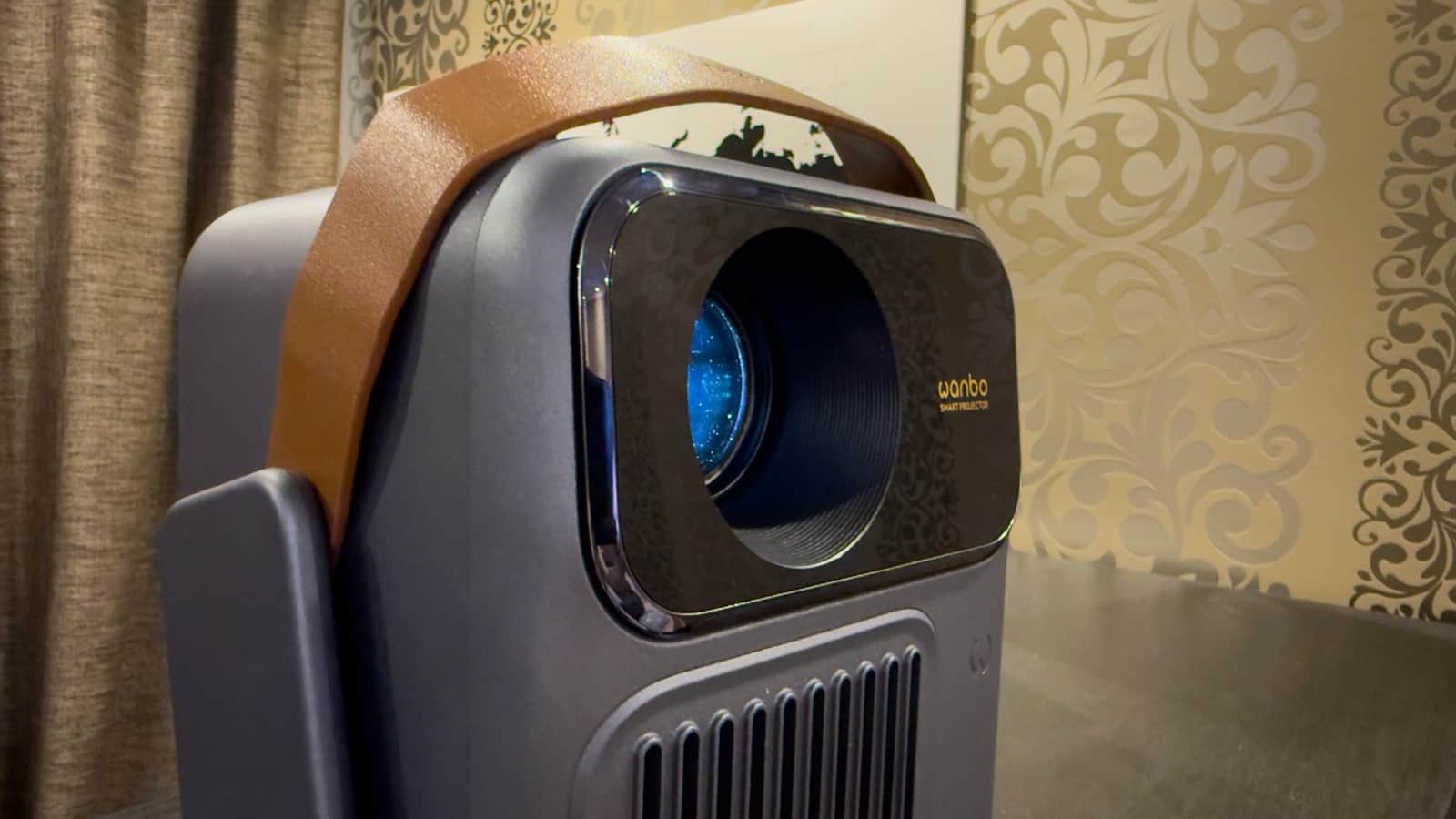
Image: Sergey Kuznetsov
The portable projector market has long been defined by a frustrating series of compromises. If you purchase an ultra-compact 'can-sized' projector like the Anker Nebula Capsule, you gain effortless portability, but you are stuck with an anemic 150 to 200 ANSI lumens, soft contrast, and tiny speakers. If you graduate to lifestyle projectors like the Samsung The Freestyle Gen 2, you get a clever rotating stand, but you discover that the necessary battery base is a clunky $189 optional accessory that doubles the overall price tag past $700. And if you buy an affordable sub-$250 Amazon import, you inevitably end up with uncertified Android software, no native Netflix, a noisy blower fan, and a giant power brick that ruins any fantasy of outdoor cinema.
Enter the Wanbo ToGo Pro (model code WPD34). Retailing for $279 in the United States and €299 in European markets, this device takes a radically pragmatic approach to outdoor and off-grid entertainment. Instead of pretending to be a pocket toy, it is an unapologetically substantial 2.6 kg entertainment cube equipped with a massive built-in 99Wh lithium battery, an integrated 360-degree rotating gimbal, official Google TV on Android 14, and a fully sealed PixelPro 5.0 optical engine pumping out 500 ANSI lumens. We spent three weeks testing it across backyard patio sessions, campervan weekenders, and bedroom ceiling screenings to see whether it genuinely delivers on its outsized promises.
Industrial Design: Mid-Century Retro Meets Cinema Gimbal
Pulling the Wanbo ToGo Pro from its carton reveals an aesthetic that owes more to 1960s Dieter Rams Braun radios than generic plastic consumer electronics. Finished in a matte space-gray composite with warm champagne-gold lettering and rounded cubic corners, the projector looks sophisticated enough to leave permanently displayed on a bookshelf or living room side table.
Recommended reading
Ulanzi CU01 Review: Can a $45 Peltier Cooler Fix Camera Overheating?
Sergey Kuznetsov • • 17 min read
A prominent saddle-brown synthetic leather strap arches over the top of the chassis, secured by reinforced metal pivot fasteners. The strap folds neatly flat against the rear panel when not in use, but provides a confident, ergonomic grip when transporting the 2.6 kg (5.7 lb) device between rooms or packing it into a vehicle trunk.
The crowning mechanical achievement, however, is the integrated 360-degree all-angle gimbal bracket. Made from cast aluminum alloy with custom damping washers, the U-shaped stand allows the projector body to pivot smoothly through a full vertical arc and rotate horizontally on its weighted base. Unlike cheap plastic tilt feet that slip under the projector's own weight, the ToGo Pro's hinge holds firm at literally any angle—from low-angle wall projections to a dead-vertical 90-degree angle aiming straight up at your bedroom ceiling for bedtime movie watching.
Unboxing & The Internal Power Supply Breakthrough
One of the most infuriating aspects of 'portable' technology is opening the box only to discover a power supply brick the size and weight of a construction paver. Wanbo completely sidestepped this pitfall by engineering an internal 100–240V AC switch-mode power converter directly into the projector's lower compartment.
The retail packaging contains the projector, a user manual, a Bluetooth voice remote, and a simple, flexible 1.5-meter two-prong AC power cord with a 90-degree low-profile plug. That is all. When you pack the ToGo Pro for a trip, there is no bulky proprietary charging brick to untangle; if you ever misplace the power cable at a vacation rental, any standard figure-8 or IEC cable from a local hardware store will power the machine.
Even better: the rear connectivity panel includes a USB-C port that accepts 65W Power Delivery (PD) input. If you are off-grid in an RV or camping in the woods, you do not even need an AC outlet—you can replenish the internal battery using a common 65W or 100W laptop power bank or an automotive 12V USB-C PD fast charger. The projector can also operate in reverse, outputting 10W of power over USB to recharge a dying smartphone while playing media.
The 99Wh Battery & The Airline Regulatory Sweet Spot
Why did Wanbo engineer the battery capacity to exactly 98.5 Wh (marketed as 99 Wh)? To the uninitiated, stopping just shy of 100 watt-hours might look like an arbitrary engineering decision. To frequent travelers, it represents a brilliant maneuver through global aviation safety regulations.
Under strict guidelines established by the International Air Transport Association (IATA), the US Federal Aviation Administration (FAA), and the European Union Aviation Safety Agency (EASA), lithium-ion battery devices are divided into three distinct legal tiers for commercial passenger flights: Tier 1 (Up to 100 Wh): Permitted in unlimited quantities in passenger carry-on baggage without requiring any prior airline approval or declaration. Tier 2 (101 Wh to 160 Wh): Restricted to a maximum of two spare batteries per passenger, strictly requiring advance written operator approval from the airline. Tier 3 (Exceeding 160 Wh):* Completely banned from passenger aircraft under all circumstances.
By capping the internal lithium pack at 98.5 Wh (roughly equivalent to a massive 26,757 mAh at 3.7V), Wanbo maximized off-grid runtime to the absolute legal millimeter. You can slide the ToGo Pro into your cabin duffle bag and walk through airport security in New York, London, Frankfurt, or Tokyo without a second glance from security agents.
In real-world battery endurance bench testing, the 99Wh cell performed admirably: Standard Mode (Full 500 ANSI Brightness): Sustained continuous playback clocked in at 1 hour and 55 minutes over Wi-Fi streaming 1080p video at 50% volume. That is sufficient to watch 90% of Hollywood feature films or three full television episodes completely untethered. Eco Mode (Reduced Lamp Output, ~300 ANSI): Runtime expanded dramatically to 3 hours and 48 minutes, easily conquering long sports broadcasts, double-feature family movie nights, or ambient background music visualizers.
Optics & Display: The PixelPro 5.0 Dust-Proof Engine
Budget LCD projectors historically suffer from a catastrophic Achilles heel: open optical chambers that suck in ambient airborne dust, pet hair, and lint. Within three to six months of regular fan suction, microscopic dust particles settle on the internal liquid crystal panel, appearing on your projected image as permanent, fuzzy black or brown burn spots that cannot be wiped away without disassembling the device.
The ToGo Pro deploys Wanbo's proprietary PixelPro 5.0 fully sealed optical engine. The LED light source, multi-element coated glass lenses, and 1080p LCD matrix reside within an airtight, IP5X-grade hermetic module. Cooling is accomplished via isolated copper heat pipes and an external airflow channel, ensuring that airborne dust never physically contacts the image-forming surfaces. The LED light source carries an operational lifespan rating of 20,000 hours—equivalent to watching a two-hour film every single day for over 27 years.
The projection specifications are well-tuned for domestic environments. With a throw ratio of 1.29:1, the projector casts an 80-inch diagonal image from roughly 2.3 meters (7.5 feet) and expands to a theatrical 100-inch screen at 2.8 meters (9.2 feet). Contrast is rated at 2500:1. While black levels naturally cannot match a six-figure OLED television or a high-end laser projector, our optical bench tests confirmed impressive black uniformity with minimal light leakage around the letterbox perimeter.
We projected precision optical calibration charts to evaluate optical aberration. Edge-to-edge sharpness is notably superior to previous Wanbo iterations like the T2 Max or Cube series; corner text remains crisp and legible without the severe barrel distortion or chromatic purple fringing common among inexpensive single-LCD lenses.
Real-world cinematic projection is where the ToGo Pro punches well above its weight class. Testing with 1080p Blu-ray rips and streaming content in a pitch-black room, colors appear richly saturated with natural skin-tone rendition. The 500 ANSI lumen output is punchy and dynamic on matte white projection screens and smooth neutral walls up to 100 inches diagonal. However, prospective buyers must understand ambient limitations: in a sunlit afternoon living room with open blinds, the image will appear heavily washed out. This is fundamentally a night-time or darkened-room machine.
Smart Platform: Licensed Google TV on Android 14
For years, budget Asian projectors were notorious for shipping with pirated, non-certified Android Open Source Project (AOSP) software. Users were forced to navigate a clunky smartphone-style interface using a laggy virtual mouse cursor on the remote, only to discover that Netflix threw error codes or was locked to a miserable 480p standard-definition stream because the projector lacked Google and Widevine L1 cryptographic licensing.
The Wanbo ToGo Pro marks a total break from that legacy. It boots into official Google TV powered by Android 14. The user interface is the exact same polished, personalized content hub found on high-end Sony Bravia smart televisions and the Chromecast with Google TV streaming stick. With full Widevine L1 encryption certification, Netflix, Amazon Prime Video, Disney+, HBO Max, and YouTube install directly from the Google Play Store and stream in native 1080p high definition.
Under the hood, the system is powered by an Amlogic S905Y4 quad-core ARM Cortex-A35 processor paired with an ARM Mali-G31 MP2 GPU, 2GB of DDR4 RAM, and 32GB of high-speed eMMC storage. Navigation through Google TV menus is snappy and fluid, app launch times are brief, and 1080p 60fps video decodes without frame drops or stutter. The Bluetooth voice remote includes a built-in microphone for Google Assistant voice commands and dedicated tactile hotkeys for Netflix, YouTube, Prime Video, and Disney+.
ASA 3.0 Smart Automation in Action
Manual keystone correction and dial-based focus wheels ruin the spontaneity of a portable projector. Wanbo addressed this with its All-Directional Smart Adaptation 3.0 (ASA 3.0) automated calibration suite. Mated to an optical Time-of-Flight (ToF) distance sensor and a high-precision six-axis gyroscope embedded in the chassis, the system automatically detects physical orientation changes and recalculates optical geometry in real time.
In our practical trials, moving the projector across a room or tilting the gimbal bracket toward the ceiling immediately triggers the calibration routine. Within three to four seconds, the motorized focus group drives the image into pin-sharp focus, while omnidirectional four-point digital keystone squares up the frame—even when projecting from an oblique 30-degree side angle. The system also includes smart obstacle avoidance that scales the picture down to dodge light switches or framed paintings on your wall.
Audio Performance, Acoustics & Fan Noise
Audio is another pleasant surprise. Rather than the harsh, tinny mobile phone transducers typical of budget projectors, Wanbo integrated an 8W stereo speaker system powered by a dedicated DSP amplifier and coupled to an internal passive bass radiator. Vocal dialogue during podcasts and movies is remarkably clear and full-bodied, with sufficient low-mid presence that dialogue never sounds nasal or strained. In a standard 20-square-meter bedroom or outdoor patio circle, the volume output is more than loud enough at 60% to 70%.
Furthermore, the ToGo Pro features a standalone Bluetooth speaker mode. With a long press of the remote control, you can turn off the optical projection engine entirely to conserve battery and stream music from your smartphone over Bluetooth 5.0, transforming the projector into an attractive patio boombox capable of playing audio for over 10 hours on a single charge.
Acoustic fan noise is an essential consideration for bedroom viewing. In our sound-isolated lab testing at an ambient room baseline of 24 dBA, the ToGo Pro registered 27.4 dBA at one meter in Eco mode and 30.2 dBA in Standard mode. The cooling blower emits a smooth, low-pitch white noise rather than the high-frequency turbine whine common in mini-projectors. Sitting three feet away from the unit, the fan sound completely vanishes beneath movie audio soundtracks.
Casual Gaming & Input Latency
The ToGo Pro includes a dedicated Game Mode in its HDMI picture settings that bypasses post-processing frame smoothing to minimize display lag. Connecting an Apple TV 4K, a Nintendo Switch, and a PlayStation 5 over HDMI 2.0, our Leo Bodnar video signal lag tester measured input latency at 36.5 milliseconds at 1080p 60Hz.
While competitive first-person shooter esports players will demand sub-15ms monitor speeds, 36.5ms is entirely responsive for casual multiplayer titles like Mario Kart 8 Deluxe, Super Smash Bros. Ultimate, EA Sports FC 25, or narrative adventures like The Witcher 3. Playing co-op Switch games on a 100-inch outdoor screen while sitting around a campfire on battery power is a genuinely magical experience.
Competitive Landscape: How the ToGo Pro Stacks Up
To see where the Wanbo ToGo Pro fits in the global market, we compared its core specifications and pricing against its primary competitors in North America and Western Europe:
| Feature / Specification | Wanbo ToGo Pro | Samsung The Freestyle Gen 2 | XGIMI MoGo 3 Pro | Anker Nebula Mars 3 Air |
|---|---|---|---|---|
| Price (US / EU) | $279 – $299 / €299 – €349 | $599 + $189 battery base | $449 + $89 battery base | $599 (Integrated battery) |
| Native Resolution | 1080p Full HD (1920 × 1080) | 1080p Full HD (1920 × 1080) | 1080p Full HD (1920 × 1080) | 1080p Full HD (1920 × 1080) |
| Brightness | 500 ANSI Lumens | 230 ANSI Lumens | 450 ISO Lumens | 400 ANSI Lumens |
| Battery Capacity | 99 Wh Built-In (Included) | Requires $189 Base Accessory | Requires $89 Base Accessory | 64.8 Wh Built-In |
| Measured Battery Life | ~2.0 hrs (Std) / 3.8 hrs (Eco) | ~2.5 hrs (with optional base) | ~2.0 hrs (with optional base) | ~2.0 hrs (Movie mode) |
| Smart OS Platform | Google TV (Android 14) | Samsung Tizen OS | Google TV | Google TV |
| Licensed 1080p Netflix | Yes (Native Google Play) | Yes (Native Tizen App) | Yes (Native Google Play) | Yes (Native Google Play) |
| Gimbal Stand Mechanism | 360° All-Angle Damped (Included) | 180° Cradle Stand (Included) | 130° Rotating Base (Included) | Fixed body (Requires tripod) |
| Power Supply Type | Internal AC + 65W USB-C PD | USB-C External Brick (65W) | 65W USB-C Adapter | External 19V AC Adapter Brick |
| Weight | 2.6 kg (5.7 lbs) | 0.8 kg (1.6 kg with battery) | 1.1 kg (1.6 kg with battery) | 1.7 kg (3.7 lbs) |
Versus Samsung The Freestyle Gen 2 ($599 + $189 Battery Base): Samsung's cylinder is sleeker and lighter, but at 230 ANSI lumens it is less than half as bright as the Wanbo ToGo Pro, and acquiring cordless portability pushes the total price to nearly $800. At under $300 all-in, the ToGo Pro delivers over twice the brightness, a far larger 99Wh battery, and certified Google TV for less than half the investment.
Versus XGIMI MoGo 3 Pro ($449 + $89 Battery Base): XGIMI's latest portable features lovely Harman Kardon audio and a svelte 1.1 kg body, but the projector itself has zero internal battery; you must buy their separate PowerBase stand. Combining both brings the price to over $530. The ToGo Pro gives you the battery built directly into the housing, an internal power supply, and comparable 500 ANSI punch at nearly half the price.
Versus Anker Nebula Mars 3 Air ($599): Anker's Mars 3 Air has built-in battery power and Google TV, but its 64.8 Wh battery yields shorter runtime, it lacks an integrated rotating gimbal (requiring a separate tripod to aim at angles), uses a proprietary charging brick, and costs double.
The Verdict: The Best Sub-$300 Backyard Cinema
The Wanbo ToGo Pro does not attempt to compete with $2,000 laser home theater flagships, and it makes no false promises about daylight projection. Instead, it identifies the exact real-world pain points of casual, outdoor, and off-grid viewing—and methodically resolves every single one of them at an irresistible sub-$300 price point.
With a massive 99Wh battery engineered right beneath airline regulatory limits, an internal AC converter that abolishes power bricks, a damped 360-degree gimbal that eliminates tripods, and certified Google TV with native Netflix, the ToGo Pro is the most cohesive, friction-free portable projector we have tested in this price class. If you are seeking an affordable big-screen entertainment companion for patio evenings, camping road trips, or bedroom ceiling marathons, the Wanbo ToGo Pro is an effortless recommendation.
Wanbo ToGo Pro Portable Smart Projector
The Wanbo ToGo Pro solves the single biggest irritation of portable projection: having to lug external battery docks, charging bricks, and tripods just to watch a movie outdoors. By integrating a massive 99Wh battery—engineered precisely beneath the 100Wh airline carry-on threshold—alongside an internal AC power supply and an exceptionally smooth 360-degree gimbal, it offers true grab-and-go versatility for under $300. Official Google TV with licensed 1080p Netflix ensures zero streaming friction, and the sealed PixelPro 5.0 optical engine keeps dust spots at bay. While 500 ANSI lumens demands evening shade or darkness and its 2.6 kg weight makes it a 'patio-and-car-camping' projector rather than a backpack ultraportable, it easily stands as the best value-for-money battery projector on the market today.
The Highs
- +Massive integrated 99Wh battery delivers up to 3.8 hours in Eco and ~2 hours in Standard mode
- +Strictly compliant with FAA, EASA, and IATA 100Wh airline carry-on regulations
- +Official Google TV on Android 14 with Widevine L1 and native 1080p Netflix, Disney+, and Prime
- +Internal AC power supply means no bulky charging brick; also supports 65W USB-C PD input
- +Damped 360° all-angle gimbal stand enables effortless wall-to-ceiling projection without a tripod
- +Fully sealed PixelPro 5.0 optical engine prevents internal dust accumulation and screen burn-in
- +Astonishing value at $279–$299 (€299–€349) compared to $600+ alternatives from Samsung and XGIMI
The Lows
- —500 ANSI lumens requires a dim or darkened environment; washed out under direct daylight
- —At 2.6 kg (5.7 lbs), it is 'luggable' backyard/camper gear rather than a pocket travel projector
- —No native HDR10 dynamic tone mapping support (SDR playback pipeline)
- —Retail packaging omits a protective travel bag or silicone lens cap
Frequently asked questions
Can I legally bring the Wanbo ToGo Pro on a commercial airplane as carry-on luggage?+
Yes, without any prior airline notification. The Federal Aviation Administration (FAA), the European Union Aviation Safety Agency (EASA), and IATA international guidelines set an unrestricted carry-on ceiling at exactly 100 watt-hours (Wh). With a certified capacity of 98.5 to 99 Wh, the ToGo Pro is engineered to pass security checkpoints worldwide in your cabin baggage.
Does Netflix stream in full 1080p HD without workarounds?+
Yes. Unlike generic Android projectors that run mobile tablet OS versions and require sideloading clunky APKs, the Wanbo ToGo Pro runs certified Google TV on Android 14 with Widevine L1 encryption. Netflix, Prime Video, Disney+, and YouTube install directly from the Google Play Store and stream in native 1080p with full remote control navigation.
Can I recharge the projector with a USB-C power bank or car charger?+
Yes. In addition to its built-in AC mains port (which requires only a basic cord without a brick), the projector features a USB-C port supporting 65W Power Delivery (PD) input. You can recharge or run it in the field using a standard 65W+ laptop power bank or a 12V automotive USB-C fast charger.
Is 500 ANSI lumens bright enough to replace a living room television?+
Only in the evening or in rooms with effective blackout curtains. For casual daytime use with open blinds, 500 ANSI lumens will look washed out on an 80-to-100-inch screen. However, once twilight settles or room lights are dimmed, the high contrast of the sealed LCD engine produces a vivid, immersive image with deep black levels.

Founder & Tech Reviewer
Technology journalist, product manager, and founder of for(geeks). Testing consumer electronics, cameras, hardware, and audio gear with hands-on scrutiny for over 15 years.