• 11 min read
Godox iT32 & X5 Review: One Flash for All Your Cameras
A featherweight speedlight with a detachable hot shoe, magnetic quick-release, and cross-brand TTL. Is Godox’s modular $99 flash the smartest lighting hack for multi-camera shooters?
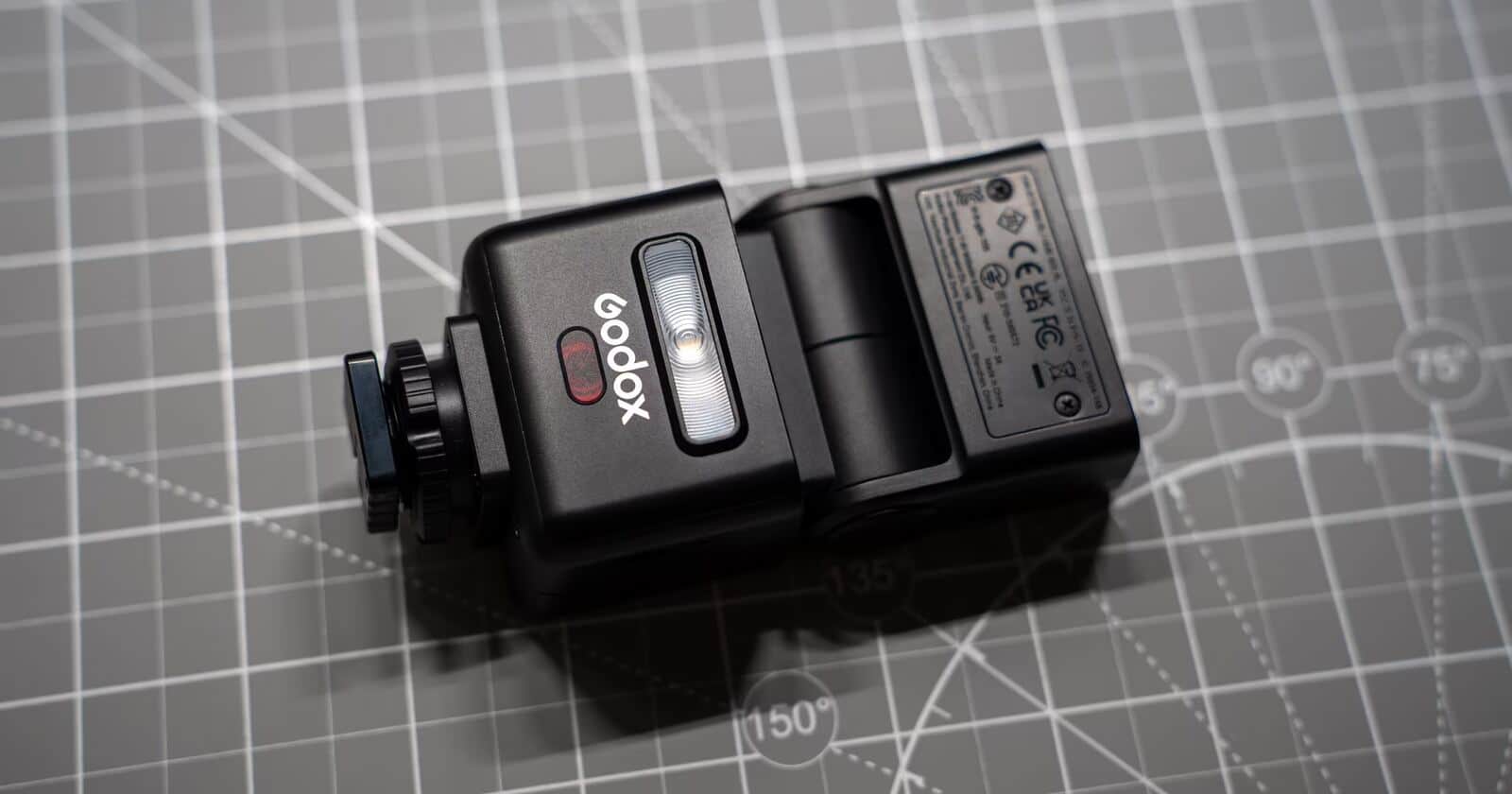
Snap the two pieces together, and you have a sleek, ultracompact on-camera speedlight. Pop the main unit off, and it instantly switches into receiver mode while the tiny X5 foot stays planted in your camera's hot shoe as a 2.4GHz radio transmitter. With a guide number of 18 at ISO 100, a total weight of just 169 grams, USB-C fast charging, and around 510 full-power flashes per charge, the Godox iT32 and X5 kit retails for roughly $99. For photographers juggling multiple camera systems, shooting on the go, or stepping into off-camera lighting for the first time, this little modular rig promises something genuinely new.
The Concept: One Flash Body, Unlimited Mounts
The defining engineering breakthrough of this system is that everything tied to your specific camera brand lives entirely inside the X5 module—a puck roughly the size of a coat button. The hot shoe contact pins, proprietary communication protocols, and wireless transmitter are all self-contained in this tiny foot. Yes, an X5 module for Sony will not fit a Canon body, and a Fuji module won't talk to a Nikon. But everything else—the xenon flash tube, lithium-ion battery, color touchscreen, and logic board—lives in the flash body and does not care what brand of camera you shoot with.
Godox manufactures dedicated X5 modules for Canon, Nikon, Sony, Fujifilm, OM System (Olympus/Panasonic), and Leica. A specialized X5 Cm module is also planned for Canon multi-function shoe bodies without a traditional center sync contact (such as the EOS R50). For other recent multi-interface Canon cameras, Godox recommends standard hot-shoe adapters listed on their compatibility guide.
The economics here are immediately compelling. Expanding your kit to support another camera system no longer means buying a whole new $200–$400 speedlight. You simply buy another standalone X5 module for $19 to $25 (or around $45 for the Leica variant). The standalone iT32 flash body costs around $79, while dedicated first-party branded speedlights from Sony or Canon cost hundreds more and remain locked to a single mount for life.

Recommended reading
Keychron Q1 HE Review: Hall Effect Switches Finally Make Sense on Mac
Sergey Kuznetsov • • 2 min read
Who benefits most from this design? Photojournalists and event shooters carrying two different camera brands on dual harnesses. Tabletop and macro photographers who value maneuverability over brute power. Everyday street photographers who carry a camera in a compact sling and refuse to haul a 450-gram speedlight. And anyone looking for a frictionless entry into off-camera flash, thanks to native integration with Godox's extensive 2.4GHz X wireless ecosystem. The only place this setup will struggle is bouncing light off high, vaulted ceilings at large venues—it simply doesn't have the guide number for that.
Design & Build Quality: Pocketable Glass and Magnets
The physical footprint of the iT32 is remarkably compact: 56 × 101 × 39 mm, tipping the scales at just 169 grams with its integrated lithium battery. The detachable X5 shoe module adds a scant 23 grams. At less than 200 grams combined, this flash moves out of the category of specialized gear you debate packing and into the realm of everyday accessories that just permanently live in your bag.
The mechanical latch between the flash body and the X5 foot relies entirely on rare-earth magnets—no twist-lock rings, levers, or screws. The hold is surprisingly tenacious. In testing, I inverted the fully assembled rig and gave it several aggressive shakes without any sign of detachment. There is a tiny vertical play of roughly 0.5 mm in the seam, but it has no impact on electrical integrity: TTL communication never dropped, and not a single frame misfired. Detaching the flash takes a clean upward pull. Reattaching occasionally requires a quick alignment check with the guide rails, but it becomes second nature within an hour of shooting.
The flash head tilts from -7° to 90°, allowing a subtle downward tilt for close-up macro framing and a straight-up vertical position for ceiling bounce. It cannot tilt backwards. Swivel is asymmetrical: 180° to the right, but only 90° to the left. On a full-size speedlight, limited left swivel would be a real headache when attempting to bounce light behind your left shoulder. Here, the modular design offers an easy workaround: you simply pull the flash off the camera, pop it onto the included magnetic desktop foot or a mini stand, and aim it anywhere you want.
This off-camera handheld configuration quickly became my favorite way to work with the iT32. Pull the flash body off the shoe, hold it in your left hand high and to the side, and fire your camera with your right hand. You get immediate, flattering directional lighting without bulky brackets, sync cords, or separate wireless triggers. Godox rates operating temperatures from -10°C to +45°C, making it reliable for brisk winter street work.
Interface, Controls & The TCM Game-Changer
The back panel features a crisp color touchscreen flanked by physical MENU and SET buttons, accompanied by a knurled rotary control dial on the right flank. The hybrid interface works intuitively: you can tap mode icons and drag sliders on the glass, or rely on the physical dial for granular power increments.
The capacitive screen is very responsive—so responsive that brushing against a jacket or camera strap can inadvertently adjust output. Godox anticipated this and included a quick lock function: a long press on the screen or dial locks the UI against accidental touches. The menu supports English and Chinese, with quick toggles for standby intervals, display brightness, boot state recall, optical slave settings, and factory reset.
The single most valuable feature in the entire firmware is TCM (TTL-Convert-Manual). The workflow is brilliant: take a test shot in TTL mode so the camera measures and calculates the exact scene exposure, then tap the TCM button. The flash immediately translates that calculated pulse into an exact manual power ratio (such as 1/16 + 0.3 EV) and locks it. You get the speed of automatic TTL metering combined with the shot-to-shot consistency of full manual flash—without ever having to guess your starting manual power level.
In the Box: Accessories Done Right
Godox deserves credit for packaging a complete, ready-to-shoot kit rather than nickel-and-diming buyers on essentials. Inside the box is the iT32 flash, a USB-C charging cable, a snap-on frosted dome diffuser, a magnetic cold-shoe foot with a 1/4-inch tripod thread, two warm magnetic CTO color-correction filters, a lens cleaning pen, and a padded storage pouch.
The snap-on diffusion dome noticeably softens harsh shadows when working at close range, while the magnetic CTO gels allow quick color balancing when matching warm indoor tungsten lighting or golden-hour sunset ambient. While I would have liked a few creative color gels (deep blues or reds) in the kit, having magnetic warm filters in the box is already ahead of most competitors.
Tucked inside the flash head itself are two built-in modifiers: a slide-out white catchlight bounce card that adds a sharp twinkle to your subject's eyes when bouncing light off the ceiling, and a wide-angle dispersion panel that spreads the flash beam to cover ultra-wide lenses down to 14mm.
Light Output, Power Realities & Battery Endurance
On paper, Godox specifies a Guide Number of 18 meters at ISO 100. There is no motorized zoom mechanism inside the head; the reflector is fixed wide, providing beam coverage roughly equivalent to a 28mm lens on full frame.
In real-world practice, in a room with a standard 2.5-meter white ceiling, the iT32 delivers clean, soft bounce illumination with reliable skin tones. However, independent laboratory measurements (including tests by Digital Camera World) indicate that actual real-world output hovers around GN 10 to 11—nearly a full stop below the manufacturer's optimistic claim. If you need to bounce off dark surfaces or high ceilings, you will quickly hit the flash's output ceiling.
Power is supplied by an integrated 7.4V 900 mAh lithium-ion cell, rated for approximately 510 full-power flashes on a full charge. When dialed down to typical fill levels (1/8 to 1/32 power), you can easily extract well over 1,000 to 1,500 pops, which is more than enough to cover a full day of active shooting. Full-power recycle time clocks in at around 1.5 seconds, dropping to virtually zero lag at lower power outputs. Recharging over USB-C takes about one hour from empty.
A continuous LED modeling light with adjustable brightness sits alongside the main flash tube. While not powerful enough to double as a primary video light, it provides excellent real-time previewing of shadow falloff and specular catchlights before you press the shutter, and doubles as an effective autofocus assist lamp in dark conditions.
Wireless Ecosystem, Sync & Triggering
Wireless communication is handled by Godox's proven 2.4GHz X wireless protocol, featuring 32 channels, 99 wireless ID security codes, and 5 distinct control groups (A–E). Working range extends up to 100 meters when triggered by standard Godox XPro or X3 transmitters, and approximately 20 to 25 meters when operating in detached mode with the miniature X5 base.
Sync options are remarkably comprehensive: standard hot-shoe triggering, optical slave modes (S1 regular optical slave and S2 TTL pre-flash ignore), and a dedicated 2.5mm sync cable port directly on the flash body. High-Speed Sync (HSS) functions up to 1/8000s across all supported camera systems, allowing you to open up fast primes to f/1.4 or f/1.8 in bright daylight while preserving ambient detail.
Field Scenarios: Where This Setup Truly Shines
The first and most obvious use case is multi-camera coverage. If you shoot with a Sony A7R V for portraits and a Fujifilm X-T5 for street or candid documentary work, you simply leave an X5-S in the Sony shoe and an X5-F in the Fuji shoe. One single flash body effortlessly hops between both cameras in two seconds, with full TTL automation and zero menu re-pairing.
The second scenario is handheld off-camera street and event portraiture. Holding the flash high in your left hand creates instant dimensionality and cheekbone definition that on-camera direct flash simply cannot replicate.
The third standout scenario is daylight fill flash under harsh sunlight. Enabling HSS at 1/4000s or 1/8000s allows you to underexpose bright blue skies while subtly filling harsh facial eye-socket shadows without blowing out skin highlights. At working distances of 1.5 to 2 meters, the iT32 delivers just enough pop to make outdoor portraits look clean and professional.
A fourth scenario is tabletop macro and product photography. Here, low minimum power output is an asset rather than a liability—you don't have to struggle with heavy neutral density filters or battle minimum flash durations. Place the flash on its magnetic foot inches from a wristwatch, jewelry piece, or keyboard, and you have complete control over reflections and fill.
Finally, the iT32 can operate as a compact wireless transmitter for Godox's larger studio strobes (such as the AD200Pro, AD300Pro, or AD600Pro). On location assignments where you want to travel light, you can leave bulky transmitters behind and use the iT32 to trigger big strobes while still having a lightweight on-axis rim or catchlight flash available.
Market Competitors & Alternatives
Within Godox's own stable, the closest sibling is the Godox iT30Pro. It is slightly lighter (120g vs 169g) with a smaller form factor and claims GN 15, but features a permanently fixed hot shoe locked to a single camera mount. In independent testing by Digital Camera World, the iT30Pro delivered an actual GN of 11—virtually identical real-world output to the iT32. If you only shoot one camera brand and count every gram, the iT30Pro is an option; but for modular versatility and off-camera speed, the iT32 is far more capable.
Below that sit the entry-level Godox iM20 and iM22. These are ultra-cheap, bare-bones manual strobes without modularity, wireless sync, or screens—designed strictly as basic pop-up flash replacements rather than creative tools. At the opposite end of the spectrum sit heavyweight workhorses like the Godox V860III ($229) and round-head V1Pro ($329). They boast GN 40+ ratings, motorized zoom heads from 24mm to 105mm, and massive batteries, but weigh three to four times as much and demand dedicated radio triggers for off-camera work.
Ultimately, the real competitor to the Godox iT32 isn't another speedlight—it is having no flash with you at all. Most photographers leave heavy strobes in their studio closet because they're simply too bulky for casual outings. The iT32 completely removes that barrier. It is small enough to live in your sling, versatile enough to work across your entire camera collection, and quick enough to transform from on-camera bounce to off-camera key light in a literal heartbeat.
Godox iT32 & X5 Modular Speedlight
The Bottom Line
“The Godox iT32 and X5 solve one of photography’s most persistent gear headaches: shooting across multiple camera systems without buying duplicate flashes. It is ultra-compact, genuinely pocketable, and magnetically converts from an on-camera TTL speedlight to an off-camera wireless key light in two seconds. While real-world power falls roughly a stop short of its claimed GN18 rating and the non-zooming head won't light up a high-ceiling banquet hall, at $99 it is an ingenious, versatile lighting tool that every travel, street, and multi-body shooter should seriously consider.”
✓The Good
- •Brilliant modular design: one flash body works across Sony, Canon, Nikon, Fuji, and Leica
- •Detaches into an off-camera wireless flash in a single smooth motion
- •Extremely compact and lightweight (under 200g total with hot-shoe module)
- •Color touchscreen with instant TCM (TTL-to-Manual) conversion
- •High-Speed Sync up to 1/8000s and full Godox 2.4GHz X-system wireless integration
- •Rich package: includes magnetic dome diffuser, CTO gels, mini stand, and USB-C charging
✕The Bad
- •Real-world output (~GN11) falls nearly a full stop short of the claimed GN18 specification
- •Fixed wide reflector with no motorized zoom; limited bounce reach on high ceilings
- •Asymmetrical horizontal swivel (180° right, but only 90° left)
- •No creative colored gels (blue/green/red) included in the retail box
Frequently asked questions
Can I use one Godox iT32 flash with both Sony and Fujifilm bodies?+
Yes. You purchase the kit for your primary camera and an extra X5 module ($19–$25) for your second system. The flash body magnetically docks onto either module with full TTL, HSS, and exposure communication.
How does the flash trigger when detached from the camera?+
The miniature X5 module stays securely locked in your camera's hot shoe and automatically functions as a 2.4GHz wireless transmitter, triggering the detached flash body up to 25 meters away.
Is the Godox iT32 powerful enough to bounce off high ceilings?+
It performs admirably with standard 8-foot (2.5m) white residential ceilings. For high vaulted ceilings or commercial event halls, its actual GN11 output will struggle, and you will need a full-sized speedlight like the Godox V1Pro.

Founder & Tech Reviewer
Sergey Kuznetsov is a technology journalist, product manager, and founder of for(geeks) and itzine.ru. With over 15 years testing consumer electronics, cameras, hardware, and audio gear, he writes hands-on reviews, technical deep-dives, and honest real-world opinions.


